Structured content

Business case/ROI Learning content Localization Personalization Replatforming Structured content Structured learning content

Cases for structured content: Accelerate global delivery and transform user experiences

Ready to see the business advantages of structured content in action? These case studies show how moving to structured content can reduce time-to-market, enable accelerated global content delivery, and deliver personalized outputs that improve user experiences.

Read More
AI Structured content Webinar

Why Cheap Content Is Expensive and How to Fix It, featuring Dawn Stevens

Will cheap content cost your organization more in the long run? In this webinar, host Sarah O’Keefe and guest Dawn Stevens share how poor workflows, inaccurate source data, and the commoditization race can undermine both product quality and brand trust. Sarah and Dawn also discuss why strategic staffing and mature content ops create the foundation your AI initiatives need to deliver reliable content at scale.

Sarah O’Keefe: I write content that’s great for today. Tomorrow, a new development occurs, and my content is now wrong. We’re down the road of “entropy always wins.” We’re heading towards chaos, and if we don’t care for the content, it’ll fall apart. So what does it look like to have a well-functioning organization with an appropriate balance of automation, AI, and staffing?

Dawn Stevens: I think that goes back to the age-old question of, “What are the skills that we really think are valuable?” We have to see technical documentation as part of the product, not just supporting the product. That means that we, as writers, are involved in all of the design. As we design the documentation, we’re helping design the UX.

Read More
AI Content pitfalls Podcasts Structured content

Futureproof your content ops for the coming knowledge collapse

What happens when AI accelerates faster than your content can keep up? In this podcast, host Sarah O’Keefe and guest Michael Iantosca break down the current state of AI in content operations and what it means for documentation teams and executives. Together, they offer a forward-thinking look at how professionals can respond, adapt, and lead in a rapidly shifting landscape.

Sarah O’Keefe: How do you talk to executives about this? How do you find that balance between the promise of what these new tool sets can do for us, what automation looks like, and the risk that is introduced by the limitations of the technology? What’s the roadmap for somebody that’s trying to navigate this with people that are all-in on just getting the AI to do it?

Michael Iantosca: We need to remind them that the current state of AI still carries with it a probabilistic nature. And no matter what we do, unless we add more deterministic structural methods to guardrail it, things are going to be wrong even when all the input is right.

Read More
Business case/ROI Podcasts

Every click counts: Uncovering the business value of your product content

Every time someone views your product content, it’s a purposeful engagement with direct business value. Are you making the most of that interaction? In this episode of the Content Operations podcast, special guest Patrick Bosek, co-founder and CEO of Heretto, and Sarah O’Keefe, founder and CEO of Scriptorium, explore how your techcomm traffic reduces support costs, improves customer retention, and creates a cohesive user experience.

Patrick Bosek: Nobody reads a page in your documentation site for no reason. Everybody that is there has a purpose, and that purpose always has an economic impact on your business. People who are on the documentation site are not using your support, which means they’re saving you a ton of money. It means that they’re learning about your product, either because they’ve just purchased it and they want to utilize it, so they’re onboarding, and we all know that utilization turns into retention and retention is good because people who retain pay us more money, or they’re trying to figure out how to use other aspects of the system and get more value out of it. There’s nobody who goes to a doc site who’s like, “I’m bored. I’m just going to go and see what’s on the doc site today.” Every person, every session on your documentation site is there with a purpose, and it’s a purpose that matters to your business.

Read More
CCMS CMS Content management Structured content Webinar

The Sky is Falling—But Your Content is Fine, featuring Jack Molisani

Every few years, a new publishing trend sends leadership into a frenzy:

  • “We need micro content for smartwatches!”
  • “Everything must go into chatbots!
  • “Get ready for VR and the Metaverse!”
  • “AI will replace our content team!”

Sound familiar?

In this episode of our Let’s Talk ContentOps webinar series, host Sarah O’Keefe and guest Jack Molisani explored how structured content will futureproof your content operations no matter what tech trends come along. Learn how to prepare content once and publish everywhere, from toasters to chatbots to jumbotrons and beyond.

Read More
Learning content Podcasts Structured content

Help or hype? AI in learning content

Is AI really ready to generate your training materials? In this episode, Sarah O’Keefe and Alan Pringle tackle the trends around AI in learning content. They explore where generative AI adds value—like creating assessments and streamlining translation—and where it falls short. If you’re exploring how AI can fit into your learning content strategy, this episode is for you.

Sarah O’Keefe: But what’s actually being said is AI will generate your presentation for you. If your presentation is so not new, if the information in it is so basic that generative AI can successfully generate your presentation for you, that implies to me that you don’t have anything interesting to say. So then, we get to this question of how do we use AI in learning content to make good choices, to make better learning content? How do we advance the cause?

Read More
Change management Webinar

How Humans Drive ContentOps (webinar)

Discover how human dynamics shape content operations in the next episode of our Let’s Talk ContentOps webinar series! Host Sarah O’Keefe interviews Kristina Halvorson, the Founder and CEO of Brain Traffic, Button Events, and an experienced content strategist. From repairing cross-silo tensions to identifying intrinsic motivations, this webinar explores strategies for navigating the human side of content operations.

In this webinar, viewers learn how to:

  • Address personalities, ambitions, and company culture
  • Balance legacy knowledge as currency
  • Foster effective collaboration
Read More
Content management Content reuse DITA Learning content Personalization Podcasts Structured content Structured learning content

The benefits of structured content for learning & development content

In this episode, Alan Pringle, Bill Swallow, and Christine Cuellar explore how structured learning content supports the learning experience. They also discuss the similarities and differences between structured content for learning content and technical (techcomm) content.

Even if you are significantly reusing your learning content, you’re not just putting the same text everywhere. You can add personalization layers to the content and tailor certain parts of the content that are specific to your audience’s needs. If you were in a copy-and-paste scenario, you’d have to manually update it every single time you want to make a change. That scenario also makes it a lot more difficult to update content as you modify it for specific audiences over time, because you may not find everywhere a piece of information has been used and modified when you need to update it.

Bill Swallow

Read More
Structured content Webinar

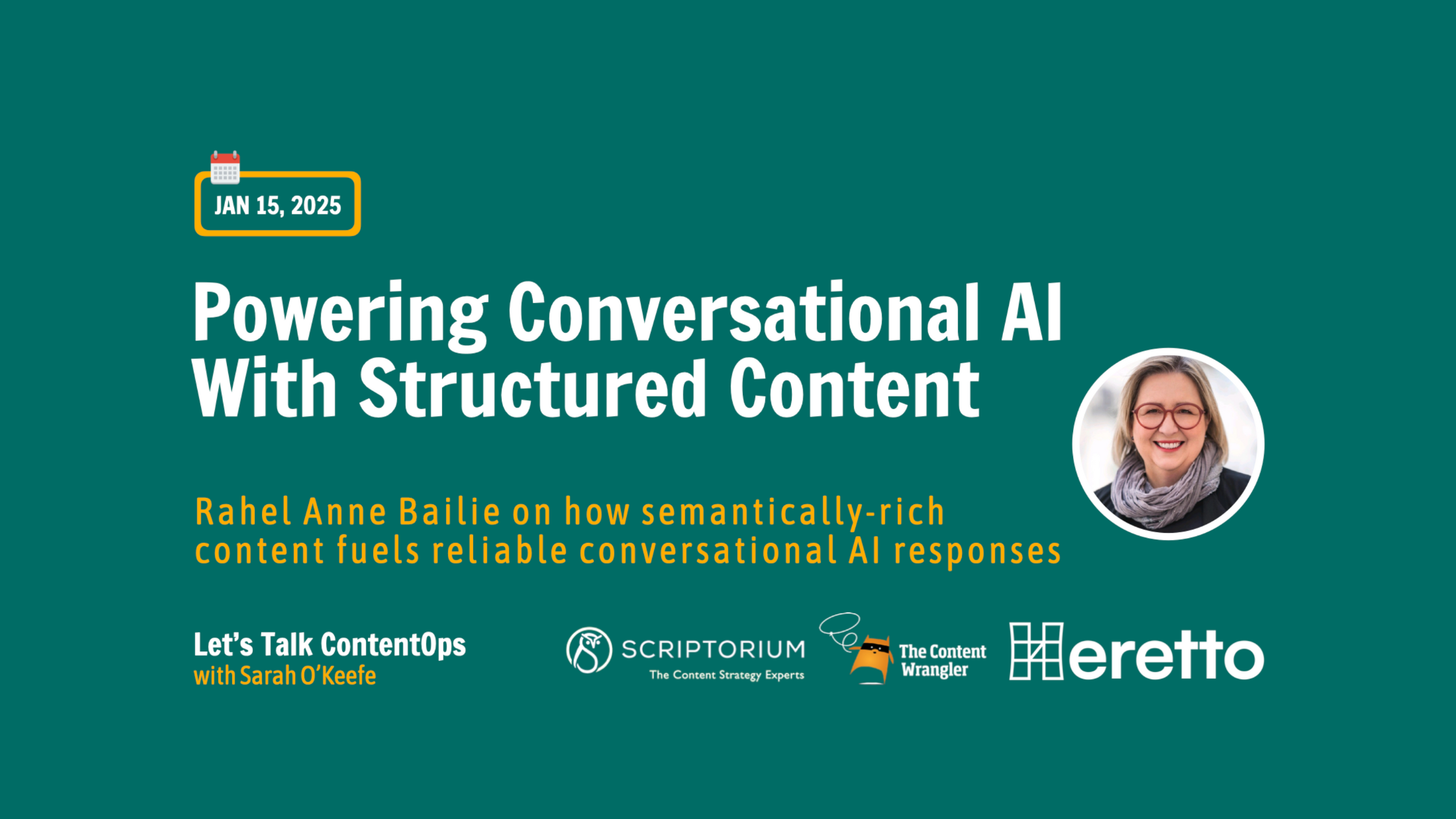
Powering Conversational AI With Structured Content (webinar)

In this episode of our Let’s Talk ContentOps! webinar series, special guest Rahel Bailie, Content Solutions Director of Technically Write IT, and host Sarah O’Keefe, Founder & CEO of Scriptorium, discuss how organizations can leverage the unlikely connection between structured content and conversational AI.

In this webinar, attendees learn:

  • What is structured content, and how it fuels reliable conversational AI responses
  • How technical writers and conversation designers can collaborate for optimal output
  • Where to get started with structured content and conversational AI
Read More
Business case/ROI Content reuse Structured content Webinar

Bridging technical and marketing content (webinar)

In this episode of our Let’s Talk ContentOps! webinar series, Scriptorium CEO Sarah O’Keefe interviewed special guest Alyssa Fox, Senior VP of Marketing at The CapStreet Group. Discover critical enterprise content strategy insights that Alyssa has gathered throughout her journey from technical writer to marketing executive.

In this webinar, viewers learn:

  • The broader picture of enterprise content operations
  • Strategies for integrating technical and marketing content
  • Best practices for using technical content as a marketing asset
Read More
Industry insights Structured content Webinar

The future of AI: structured content is key (webinar)

In this episode of our Let’s Talk ContentOps! webinar series, industry experts Sarah O’Keefe and Carrie Hane explore the intersection of structured content and artificial intelligence. Discover how structured content improves the reliability and performance of AI systems by increasing accuracy, reducing hallucinations, and supporting efficient content management.

In this webinar, attendees will learn:

  • AI’s capabilities and limitations
  • How structured content enhances AI abilities in content management, personalization, and distribution
  • Best practices for integrating AI and structured content
Read More
Change management DITA Podcasts Replatforming Structured content

Survive the descent: planning your content ops exit strategy

Whether you’re surviving a content operations project or a journey through treacherous caverns, it’s crucial to plan your way out before you begin. In episode 176 of the Content Strategy Experts podcast, Alan Pringle and Christine Cuellar unpack the parallels between navigating horror-filled caves and building a content ops exit strategy.

Alan Pringle: When you’re choosing tools, if you end up something that is super proprietary, has its own file formats, and so on, that means it’s probably gonna be harder to extract your content from that system. A good example of this is those of you with Samsung Android phones. You have got this proprietary layer where it may even insert things into your source code that is very particular to that product line. So look at how proprietary your tool or toolchain is and how hard it’s going to be to export. That should be an early question you ask during even the RFP process. How do people get out of your system? I realize that sounds absolutely bat-you-know-what to be telling people to be thinking about something like that when you’re just getting rolling–

Christine Cuellar: Appropriate for a cave analogy, right?

Alan Pringle: Yes, true. But you should be, you absolutely should be.

Read More
CCMS CMS DITA Industry insights Podcasts Structured content

Enterprise content operations in action at NetApp (podcast)

Are you looking for real-world examples of enterprise content operations in action? Join Sarah O’Keefe and special guest Adam Newton, Senior Director of Globalization, Product Documentation, & Business Process Automation at NetApp for episode 175 of The Content Strategy Experts podcast. Hear insights from NetApp’s journey to enterprise-level publishing, lessons learned from leading-edge GenAI tool development, and more.

We have writers in our authoring environment who are not writers by nature or bias. They’re subject matter experts. And they’re in our system and generating content. That was about joining us in our environment, reap the benefits of multi-language output, reap the benefits of fast updates, reap the benefits of being able to deliver a web-like experience as opposed to a PDF. But what I think we’ve found now is that this is a data project. This generative AI assistant has changed my thinking about what my team does. Yes, on one level, we have a team of writers devoted to producing the docs. But in another way, you can look at it and say, well, we’re a data engine.

— Adam Newton

Read More
Business case/ROI Change management Podcasts Structured content

Position enterprise content operations for success (podcast)

In episode 174 of The Content Strategy Experts podcast, Sarah O’Keefe and Alan Pringle explore the mindset shifts that are needed to elevate your organization’s content operations to the enterprise level.

If you’re in a desktop tool and everything’s working and you’re happy and you’re delivering what you’re supposed to deliver and basically it ain’t broken, then don’t fix it. You are done. What we’re talking about here is, okay, for those of you that are not in a good place, you need to level up. You need to move into structured content. You need to have a content ops organization that’s going to support that. What’s your next step to deliver at the enterprise level?

— Sarah O’Keefe

Read More
CCMS Content reuse DITA Localization Podcasts Structured content

Conquering content localization: strategies for success (podcast)

Translation troubles? This podcast is for you! In episode 173 of The Content Strategy Experts podcast, Bill Swallow and special guest Mike McDermott, Director of Language Services at MadTranslations, share strategies for overcoming common content localization challenges and unlocking new market opportunities.

Mike McDermott: It gets very cumbersome to continually do these manual steps to get to a translation update. Once the authoring is done, ideally you just send it right through translation and the process starts.

Bill Swallow: So from an agile point of view, I am assuming that you’re talking about not necessarily translating an entire publication from page one to page 300, but you’re saying as soon as a particular chunk of content is done and “blessed,” let’s say, by reviewers in the native language, then it can immediately go off to translation even if other portions are still in progress.

Mike McDermott: Exactly. That’s what working in this semantic content and these types of environments will do for a content creator. You don’t need to wait for the final piece of content to be finalized to get things into translation.

Read More