Webinars
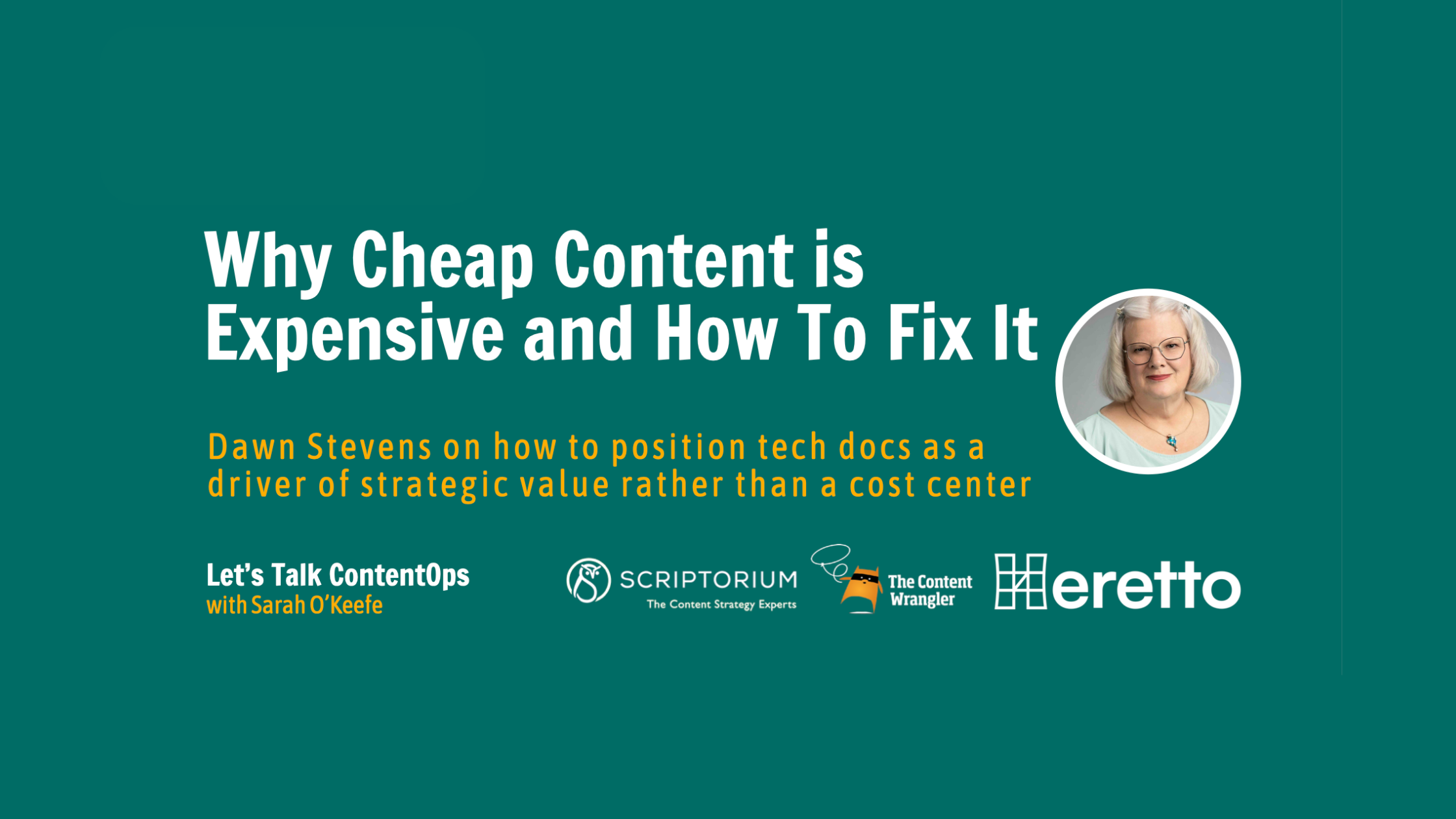
Why Cheap Content Is Expensive and How to Fix It, featuring Dawn Stevens
Will cheap content cost your organization more in the long run? In this webinar, host Sarah O’Keefe and guest Dawn Stevens share how poor workflows, inaccurate source data, and the commoditization race can undermine both product quality and brand trust. Sarah and Dawn also discuss why strategic staffing and mature content ops create the foundation your AI initiatives need to deliver reliable content at scale.
Sarah O’Keefe: I write content that’s great for today. Tomorrow, a new development occurs, and my content is now wrong. We’re down the road of “entropy always wins.” We’re heading towards chaos, and if we don’t care for the content, it’ll fall apart. So what does it look like to have a well-functioning organization with an appropriate balance of automation, AI, and staffing?
Dawn Stevens: I think that goes back to the age-old question of, “What are the skills that we really think are valuable?” We have to see technical documentation as part of the product, not just supporting the product. That means that we, as writers, are involved in all of the design. As we design the documentation, we’re helping design the UX.


Structured Learning Content That’s Built to Scale, featuring Becky Mann
Teams are under pressure to do more—more formats, languages, publishing outputs, and audiences. After an acquisition, CompTIA faced fragmented systems, manual processes, and time-consuming formatting. In this webinar, see how CompTIA used structured learning content operations to scale globally and meet evolving delivery demands.
Now, we have a central content ecosystem where everything connects into one spot—our CCMS—where we can actually publish in many different ways. We can do our translations very seamlessly now with our translation memory service linked in. We can publish directly to our LMS record, and we can also deploy PDFs. There’s some other little things that we’ve developed over the years. For example, we map our content to the exam objectives for our certifications. That was always a very manual process. It is now automated, which is amazing.
— Becky Mann

The Sky is Falling—But Your Content is Fine, featuring Jack Molisani
Every few years, a new publishing trend sends leadership into a frenzy:
- “We need micro content for smartwatches!”
- “Everything must go into chatbots!
- “Get ready for VR and the Metaverse!”
- “AI will replace our content team!”
Sound familiar?
In this episode of our Let’s Talk ContentOps webinar series, host Sarah O’Keefe and guest Jack Molisani explored how structured content will futureproof your content operations no matter what tech trends come along. Learn how to prepare content once and publish everywhere, from toasters to chatbots to jumbotrons and beyond.
How CompTIA rebuilt its content ecosystem for greater agility and efficiency (webinar)
After an acquisition, CompTIA faced the challenge of unifying multiple content systems, editorial teams, and delivery formats. To tackle this, they implemented a centralized, structured content model supported by a robust content management system. This webinar details how CompTIA overhauled its content operations from strategy through implementation without a pause in production.
Now we’re going to start seeing the true benefits of working in DITA, which is what I’m most excited about. We can maintain our content easily and focus on where things are changing versus converting, rearranging, or recopying content. I’m excited to see how our efficiencies gain as we move into our refresh cycle.
— Becky Mann


Ready, set, AI: How to futureproof your content, teams, and tech stack (webinar)
Your customers expect intelligent, AI-powered experiences. Is your content strategy ready for an AI-driven world? After a popular panel at ConVEx San Jose, the team at CIDM brought the conversation online in this webinar.
AI is going to require us to think about our content across the organization, across the silos, because at the end of the day, the AI overlord, the chatbot is out there slurping up all this information and regurgitating it. The chatbot doesn’t care that, for example, I work in group A, Marianne’s in group B, and Dipo’s in group C, and we don’t talk to each other. The chatbot, the world, the consumer, sees us all in the same company. If we’re all part of the same organization, why shouldn’t it be consistent?
— Sarah O’Keefe


How Humans Drive ContentOps (webinar)
Discover how human dynamics shape content operations in the next episode of our Let’s Talk ContentOps webinar series! Host Sarah O’Keefe interviews Kristina Halvorson, the Founder and CEO of Brain Traffic, Button Events, and an experienced content strategist. From repairing cross-silo tensions to identifying intrinsic motivations, this webinar explores strategies for navigating the human side of content operations.
In this webinar, viewers learn how to:
- Address personalities, ambitions, and company culture
- Balance legacy knowledge as currency
- Foster effective collaboration
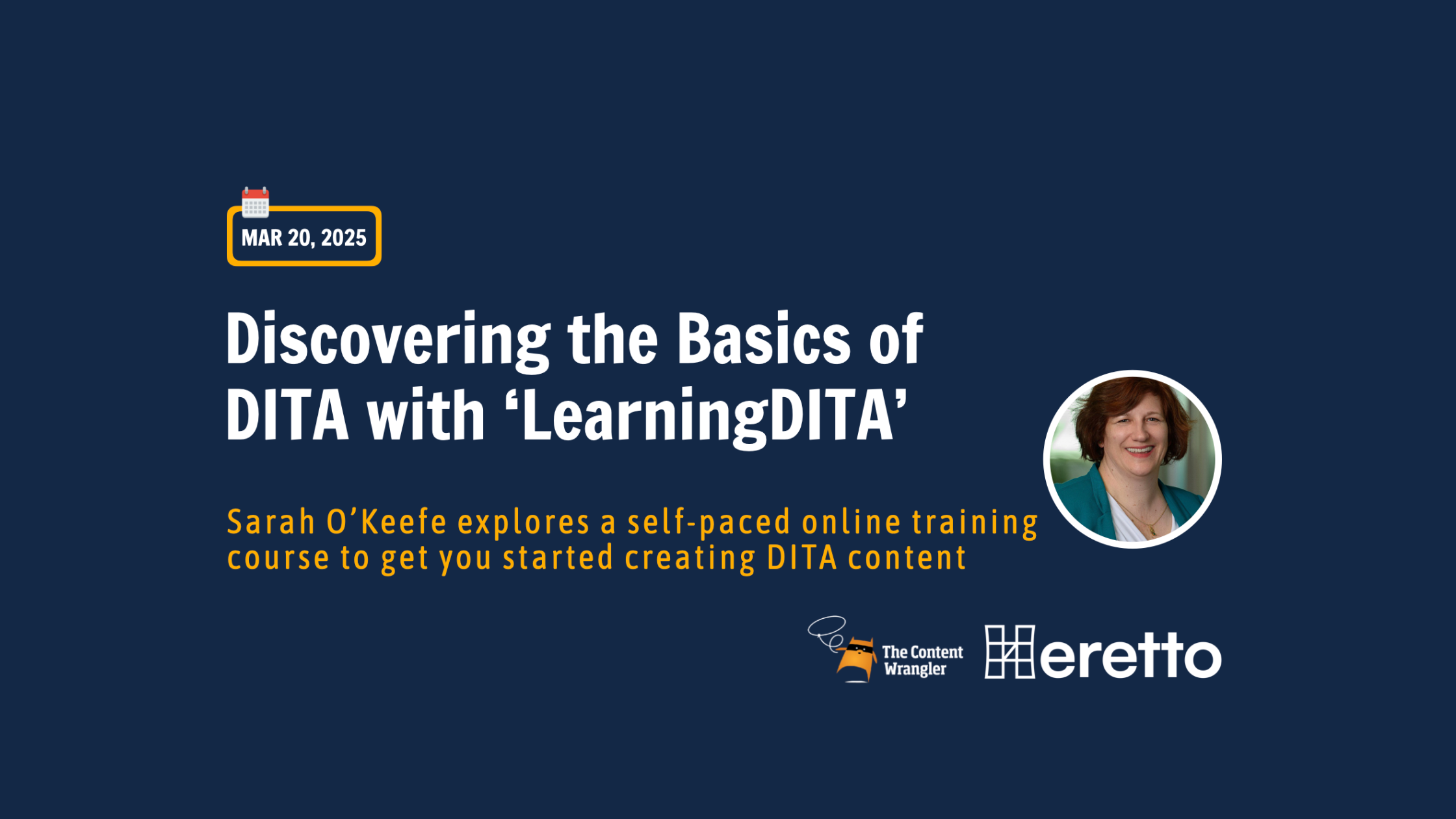
Discovering the Basics of DITA with LearningDITA (webinar)
In this webinar, Sarah O’Keefe shares the basics of DITA—what it is, why it’s crucial for creating structured content, and how it revolutionizes consistency and efficiency in documentation. By exploring core elements such as topics, maps, and metadata, along with DITA specializations like task, concept, and reference topics, you’ll learn why organizations around the globe use DITA to craft modular, reusable content and put it to work.
You’ll be introduced to a self-paced, online DITA training resource called LearningDITA. Lessons include exercises, links to additional resources and videos, and quizzes to test your knowledge.
What DITA offers is a mechanism for extensibility that doesn’t break the standard. If you’re going to try to build out a system that is futureproof, as best we can without knowing the future, then we need flexibility. We need the ability to change things as we go, to extend, to add new output types, to add new semantics, to add new metadata, to add new systems into the equation.
— Sarah O’Keefe
Transforming The Future: ContentOps In The Age Of AI (webinar)
In this episode of our Let’s Talk ContentOps webinar series, Scott Abel, The Content Wrangler himself, talks about the future of content operations in the age of artificial intelligence. You may know Scott from his work as a consultant, conference presenter, and talk show host, but in this session, we turn the spotlight back on Scott and ask him what HE thinks about the future of content ops.
Viewers will learn how AI is reshaping content operations, including:
- Creating seamless system connectivity
- Transforming content creation, management, and delivery
- Changing how platforms for professional content creators work
Powering Conversational AI With Structured Content (webinar)
In this episode of our Let’s Talk ContentOps! webinar series, special guest Rahel Bailie, Content Solutions Director of Technically Write IT, and host Sarah O’Keefe, Founder & CEO of Scriptorium, discuss how organizations can leverage the unlikely connection between structured content and conversational AI.
In this webinar, attendees learn:
- What is structured content, and how it fuels reliable conversational AI responses
- How technical writers and conversation designers can collaborate for optimal output
- Where to get started with structured content and conversational AI

Bridging technical and marketing content (webinar)
In this episode of our Let’s Talk ContentOps! webinar series, Scriptorium CEO Sarah O’Keefe interviewed special guest Alyssa Fox, Senior VP of Marketing at The CapStreet Group. Discover critical enterprise content strategy insights that Alyssa has gathered throughout her journey from technical writer to marketing executive.
In this webinar, viewers learn:
- The broader picture of enterprise content operations
- Strategies for integrating technical and marketing content
- Best practices for using technical content as a marketing asset
The future of AI: structured content is key (webinar)
In this episode of our Let’s Talk ContentOps! webinar series, industry experts Sarah O’Keefe and Carrie Hane explore the intersection of structured content and artificial intelligence. Discover how structured content improves the reliability and performance of AI systems by increasing accuracy, reducing hallucinations, and supporting efficient content management.
In this webinar, attendees will learn:
- AI’s capabilities and limitations
- How structured content enhances AI abilities in content management, personalization, and distribution
- Best practices for integrating AI and structured content

Content ops forecast: mostly sunny with a chance of chaos (webinar)
In this episode of our Let’s Talk ContentOps! webinar series, Scriptorium principals Sarah O’Keefe (CEO), Alan Pringle (COO), and Bill Swallow (Director of Operations) provide practical insights on the future of content operations. They’ll deliver sunny predictions, warn of upcoming storms, and equip you to weather unprecedented fronts in the content industry.

Managing content with tools beyond your control (webinar)
In this episode of our Let’s talk ContentOps! webinar series, Pam Noreault, Principal Information Architect at Ellucian, and Sarah O’Keefe, CEO of Scriptorium, discuss the dynamics of authoring teams whose tools are controlled by IT or third-party SaaS ecosystems.
AI needs content operations, too (webinar)
In this episode of our Let’s talk ContentOps! webinar series, Scriptorium CEO Sarah O’Keefe and special guest Megan Gilhooly, Sr. Director Self-Help and Content Strategy at Reltio, explore how to successfully integrate AI into your content operations. They discuss how to use AI as a tool, how to create content that an AI can successfully consume, and how the role of the writer will shift in a GenAI world.
In this webinar, you’ll learn
- The role of content in training the AI
- How semantic content drives chatbots
- How AI may change the way you write
- How to adapt in a GenAI world
Building the business case for content operations (webinar)
Organizations are recognizing the need for a strategic approach to content creation, management, and distribution, but content operations require upfront and continued investment. In this episode of our Let’s Talk ContentOps! webinar series, Sarah O’Keefe and special guest Mark Kelley discuss how to build the business case for content operations.
In this webinar, you’ll learn
- Why you must understand the connection between the proximity of content ops to revenue
- How to position your business case for maximum success
- When to consider the role of generative AI when seeking funding for content ops
Content ops 2024 boom or bust? (webinar)
Scriptorium principals Sarah O’Keefe, Alan Pringle, and Bill Swallow have decades of experience in the content industry. In this webinar, they share their analysis of key content operations trends.
After watching, you’ll learn
- Three key trends in content operations
- The predicted impact of these trends in 2024
- How your organization should adapt

Content as a Service: the backbone of modern content operations (webinar)
In this presentation, Divraj Singh of Adobe and Sarah O’Keefe explore the concept of Content as a Service and provide CaaS examples.
“In a Content as a Service model, content creators write the content and make it available. Then the consumer gets to format that content and read or consume it in whatever way they want. ”
– Sarah O’Keefe

Smarter content in weird places (webinar)
In this presentation, Bill Swallow explores the weird yet effective applications of smart content in groups outside of techcomm.
“Moving to smart content or intelligent content has largely so far been driven by efficiency. But the places that are looking at using smarter content now are less interested in the efficiency of that content. They’re more interested in the value that it’s going to bring.”
– Bill Swallow

Content reuse: How do you recognize redundancy? (webinar)
How do you recognize content redundancy? Chris Hill of DCL and Alan Pringle discuss content reuse and share some great insights about managing reuse as part of your content strategy.
“You are going to be reducing your localization costs, because every time you reuse and reduce the amount of source content, you are doing the same exact thing in every language that you’re translating to.”
–Alan Pringle


Unifying customer experience with enterprise content strategy (webinar)
Does your website include content from multiple departments? If so, you need an enterprise content strategy rather than a departmental strategy. Enterprise content strategy addresses each content type as part of the overall user experience.
In this presentation, Elizabeth Patterson explores how to build a holistic content strategy across your customer-facing content groups.
“Your content needs to be searchable, it needs to be consistent, and prospects need to be able to find it efficiently.”
—Elizabeth Patterson


Think global, act global, go global (webinar)
Entering new language markets requires more than just translation. To succeed, people from across your organization need to collaborate and begin thinking globally. Bill Swallow talks about how to get started and provide a unified, localized customer experience.
“Going global is not a simple decision. You can’t just throw things out into the wild and expect them to be taken at face value. There are going to be language differences, there are going to be cultural differences, and there are going to be regulatory differences.”
—Bill Swallow
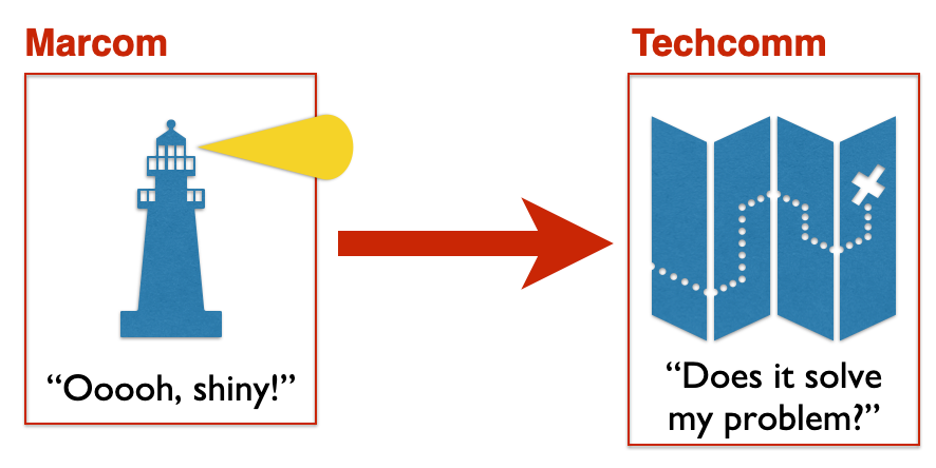
Why technical communication must be part of your marketing strategy (webinar)
Sarah O’Keefe talks about why your technical communication needs to become part of your marketing strategy.
“Technical content is being read before the sale. Buyers are not limiting themselves to what they can find in your marketing content, they’re looking for what matters to them and what they’re trying to do.”
—Sarah O’Keefe

Not all digital is transformation (webinar)
Gretyl Kinsey shares some examples of digital content production done well and not-so-well, and discusses practical tips for ensuring that you make the most out of your digital transformation.
“Digital transformation is the use of technology to enrich information delivery.”
—Gretyl Kinsey


InDesign and DITA (webinar)
Jake Campbell talks about how you can utilize automated processes in a high-design environment.
“When we’re looking at high-design, we have a focus on form. When we’re looking at automated workflows, we’re looking at a focus on the content itself.”
—Jake Campbell


Taxonomy planning (webinar)
Bill Swallow and Gretyl Kinsey share some of the most important steps to take when planning for your taxonomy in The Content Strategy Experts Webcast.
“When starting with a taxonomy, never start with a blank slate, because chances are somebody has done something already.”
—Bill Swallow

Webcast recording: Balancing standardization against the need for creativity
In this recorded webcast, learn about three cases studies that show how companies balance standardization and creativity in XML publishing.

Webcast: The technology is the easy part! Leading through change
Change is constant in technical communication. Whether dealing with new technology, shifts in organizational structures, or growing business requirements, content creators must be able to adapt. In this webcast recording, a panel of content experts—Jack Molisani of The LavaCon Conference and ProSpring Staffing, Erin Vang of Dolby Laboratories, Sarah O’Keefe of Scriptorium, and moderator Toni Mantych of ADP—answer questions and give advice about dealing with change in the industry.

Webcast: 2016 content trends
In this webcast recording, Scriptorium’s Alan Pringle, Bill Swallow, and Gretyl Kinsey look at 2016 trends in content and content strategy. Sarah O’Keefe moderates.
Webcast: Risky business: the challenge of content silos
In this webcast recording, Sarah O’Keefe discusses how content silos make it difficult to deliver a consistent, excellent customer experience. After all the hard work that goes into landing a customer, too many organizations destroy the customer’s initial goodwill with mediocre installation instructions and terrible customer support.
Do you have a unified customer experience? Do you know what your various content creators are producing? Join us for this thought-provoking webcast.

Webcast: Content Strategy vs. The Undead
Implementing a content strategy often involves overcoming significant technological and cultural challenges, but some of these challenges are so scary, so heinous, that they earn a place among the undead because they Just. Won’t. Die!
In this webcast, which debuted at Lavacon 2014, Bill Swallow takes a look at these nightmare-inducing monsters—from unrelenting copy-and-paste zombies to life-draining, change-avoiding vampires—and shows you what can be done to keep your content strategy implementation from turning into a fright fest.
Content strategy for tech comm and beyond
Having trouble with your technical content process? Need a strategy that can help you improve and scale? Before you make a change, talk to the other content-producing groups in your company—marketing, training, sales, support—to develop a content strategy that works across the entire organization.
Webcast: Understanding the need for XML and structured content
In this webcast, Sarah O’Keefe provides a basic introduction to XML and explains how it could affect your content creation efforts. This presentation emphasizes the overall concept and has minimal technical content.
Webcast: The many facets of content strategy
In this webcast recording, Sarah O’Keefe discusses the future of content strategy.
The purpose of content strategy is to support your organization’s business goals. Content strategists need to understand how content across the organization—marketing, technical, and more—contributes to the overall business success.
Webcast: You want it when?!? Content strategy for an impatient world
In this webcast recording, Sarah O’Keefe discusses how content initiatives are putting new demands on technical communication—improving customer experience, building interactive documents, including advanced visualizations, integrated translations, and more.

Webcast: The Bottom Line: Globalization and the Dependence on Intelligent Content
In this webcast recording, Bill Swallow takes a look at intelligent content’s role in global markets, and how the entire content cycle directly affects a business’s bottom line (revenue).
Webcast: Trends in technical communication 2014
In this webcast recording, Sarah O’Keefe and Bill Swallow of Scriptorium Publishing discuss what’s new in technical communication. Alan Pringle moderates.
Webcast: The many facets of accessibility in technical communication
Whether you’re using relative font sizes for those with low vision, or keyboard functionality for those with motor issues, creating more accessible tech comm content for people with disabilities also makes it easier to navigate and follow for people without disabilities.
Webcast: Mobile content strategy is no longer optional
Does your company have a strategy for making content available through mobile devices? Are you currently or do you plan to be part of the rapidly growing Bring Your Own Device (BYOD) movement? Do you have a content management system that makes your content accessible for a variety of purposes on the many mobile devices that are currently on the market today?
Webcast: Content strategy for technical communication
In this webcast recording, Sarah O’Keefe discusses how to get started with content strategy for technical communication.
Webcast: Ending the Cold War between techcomm and marcom
In this webcast recording, Sarah O’Keefe discusses various strategic initiatives that require coordination between marcom and techcomm and addresses how to begin to thaw out the relationship.
Webcast: DITA and content strategy
In this webcast recording, Sarah O’Keefe discusses content strategy and the role of DITA in content strategy.
Webcast: The state of the tech comm industry
In this webcast recording, Sarah O’Keefe, Scott Abel (The Content Wrangler), Race Bannon (Oracle), and Paul Perrotta (Juniper Networks) discuss the state of the technical communication industry.
Webcast: The realities of ebook distribution
In this webcast recording, Alan Pringle discusses the challenges of ebook distribution and how Scriptorium has addressed them when selling EPUB and Kindle editions. Topics covered include:
- Formatting differences in ereader devices and apps
- Pricing
- Other lessons learned through painful experience
Webcast: Pros and cons of the DITA Open Toolkit
In this webcast recording, Simon Bate discusses the pros and cons of using the DITA Open Toolkit. Topics include localization, automation, open standards, and plugin architecture on the pro side; plugin architecture, PDF configuration, open standards, and documentation on the con side.

Webcast: Ensuring success with your CCMS
In this webcast, guest presenter Chip Gettinger of SDL discusses key success factors for component content management systems.
Webcast: Trends in technical communication, 2013
Our trends webcast has become an annual event, and it’s our most popular webcast! Each year, we take our best shot at trends for the upcoming year with a mixture of serious and not-quite-serious predictions. In this webcast recording, Sarah O’Keefe and special guest Bill Swallow, aka techcommdood, share their perspectives on trends for 2013.
Webcast: To DITA or not to DITA
In this webcast recording, guests Alyssa Fox (NetIQ) and Toni Mantych (ADP) discuss their differing DITA implementation decisions.
Webcast: Six easy ways to control your localization costs
In this webcast recording Bill Swallow, the manager of the GlobalScript division at LinguaLinx, discusses some of the ways you can cut your localization costs while still delivering quality content.
Update 9/26/2014: Bill now works for Scriptorium.
Webcast: DITA 101
In this webcast recording, Sarah O’Keefe gives an overview of DITA, one of the major structured authoring standards in tech comm. You’ll also learn about DITA concepts, the business case for DITA, and typical scenarios where DITA is used.
Vendor webcast: An overview of authoring DITA with oXygen
In this webcast recording, George Bina shows you how to create DITA content from zero to a full deliverable using oXygen. The full deliverable leads to multiple publishing formats.
Webcast: Collaboration: A hands-on demo using Confluence wiki
In this video recording, guest presenter Sarah Maddox explains why collaboration is a good thing, why a wiki is a good solution for it, and how to do it on Confluence.
Webcast: Ask the experts panel
In this interactive session, technical communication experts Sarah O’Keefe, Nicky Bleiel, and Tony Self give their opinions about important current topics in the industry.
Webcast: Transition to XML
Simon Bate provides a planning framework for implementing an XML-based structured authoring environment.
Vendor webcast: Collaborative content development with easyDITA
Paul Wlodarczyk shows how cloud-based tools like easyDITA can change the way you approach collaboration, and in turn speed your time to publish and simplify your work process.
Vendor Webcast: Bring your DITA content to the next level with IXIASOFT
Have you ever wondered how to effectively manage your DITA content as it continues to grow? Jean-François Ameye shows how IXIASOFT’s full featured DITA CMS solution handles your entire technical documentation process from authoring and searching to reviewing and publishing.
Webcast: HTML5 and its impact on technical communication
In this webcast recording, guest presenter Peter Lubbers gives a fast-paced overview of HTML5 with a focus on how it affects the tech comm field. He covers what exactly HTML5 is, why you should care, and how you can develop with HTML5. The session covers which browsers support which features, and how you can make the new features work in older browsers so you can start using HTML5 today.
Webcast: The Changing Role of the Professional Technical Communicator: What’s Next?
In this webcast recording, Scott Abel, The Content Wrangler, and Val Swisher, CEO of Content Rules, host a lively discussion with technical communication industry professionals Jack Molisani and Sarah O’Keefe. The four discuss the impact of globalization, outsourcing, off-shoring, technological advances, and mobile devices on the technical communication landscape.
Webcast: Trends in technical communication, 2012
In this webcast recording, Sarah O’Keefe and guest presenter Char James-Tanny discuss tech comm trends for the upcoming year and beyond. Topics include use of the cloud, help authoring tool innovation, business value, adoption of standards, shift to mobile, and more.
Webcast: Content strategy in technical communication
In this webcast recording, Sarah O’Keefe explores how to develop a content strategy specifically for technical content. That means stepping back from the temptation to focus on tools and instead taking a hard look at what the users need and how best to deliver it.
2012 resolution: Explore the frontiers of tech comm with Scriptorium
Our 2012 event schedule is starting to come together. Our guest speaker lineup includes Char James-Tanny, Peter Lubbers, and Sarah Maddox, with more to be announced.
This year, we are changing our conference schedule somewhat. I am looking forward to participating in Intelligent Content for the first time, and Simon is going around the world for tcworld India.
Webcast: The economics of information
In this webcast recording, Sarah O’Keefe discusses how the cost of developing content affects what is actually created. She leads with a discussion of Gutenberg and how we went from gorgeous, unaffordable, artistic books that took years to produce to more plebeian but affordable books. Then she considers today’s situation, with particular attention to the possibilities of video, information apps, and a look at what has NOT changed.
Webcast: Content strategy for software development (with Ray Gallon)
Content strategy is usually thought of in the context of web development. But today’s software is increasingly information-rich. Software is a content vector, and we need to manage the life cycle of that content. This webcast from guest speaker Ray Gallon adapts content life cycle management principles, taken from web-oriented content strategy, to software development cycles. Some examples from real experiences illustrate this adaptation.
Webcast: Localization and the DITA Open Toolkit
Out of the box, the DITA Open Toolkit (OT) looks like it’s localization-ready. It handles the XML attribute xml:lang. It contains strings for more than 50 localizations. So it would seem that all you have to do is specify the language in your DITA files and maps and you’re good to go…or are you? In this webcast, I’ll discuss some of the issues Scriptorium has encountered while generating localized output from the DITA Open Toolkit—and how we solved them.
Webcast: DITA OT essentials
In this webcast, Simon Bate provides a “gentle introduction” to the DITA Open Toolkit (OT), the standard way to generate deliverables from DITA documents. This presentation shows how anyone can install the OT. A tour of the contents and how the plugin architecture works is included.
Webcast: Crafting Clarity in a Climate of Chaos
Scriptorium hosts Tristan Bishop of Symantec as he discusses what technical writers need to do to keep up with transforming communication methods and rapid advances in global, mobile, and social dialog.
Webcast: DITA Best Practices
In this webcast hosted by Scriptorium, author Tony Self discusses his new book, The DITA Style Guide, and how it fits into a DITA workflow.
Webcast: Attractive DITA: it is possible!
In this webcast, Sarah O’Keefe discusses the challenges of getting attractive output from DITA and demonstrates Scriptorium’s approach to web-based help and PDF.
Webcast: Calculating the ROI for XML and DITA topic-based authoring
In this webcast, Sarah O’Keefe discusses how to calculate the return on investment of an XML/DITA implementation for technical content.
If you are considering XML and DITA, but are trying to figure out whether you can justify the cost and effort, this session is for you.
Webcast: Content strategy analysis for technical communication
In this webcast, Sarah O’Keefe of Scriptorium offers an overview of content strategy analysis with an eye toward the implications and business case for your organization.
Webcast: XSL techniques for XML-to-XML transformations
In this webcast, Simon Bate leads viewers through the key steps in using XSL (extensible stylesheet language) to perform XML-to-XML conversions, a process that differs from more traditional XML-to-PDF and XML-to-HTML conversions.
Webcast: Extracting deliverables from DITA
In this webcast, Sarah O’Keefe of Scriptorium surveys DITA’s publishing options and weighs their practical implications.
Webcast: Knowledge integration: The future of technical communication
Scriptorium hosts Tristan Bishop of Symantec as he muses on technical communicators’ evolving roles.
Is tech comm management different in an XML environment?
I think so. Read the white paper and see if you agree.
Webcast: Managing technical communicators in an XML environment
In this 41-minute webcast, Sarah explores how XML affects the management of technical communication and proposes a new system for measuring documentation quality.
Trends in technical communication webcast
After some “interesting” technical challenges, the recording of our Trends in technical communication webcast is now available on Slideshare:
Webcast: Trends in technical communication for 2010
Sarah O’Keefe, Ellis Pratt of Cherryleaf, and Tony Self of Hyperwrite
Find out where these three presenters see the industry going. This event is for managers with tech comm responsibility, with or without prior technical writing experience.
Webcast: DITA-FMx demonstration
This webcast demonstrates using the DITA-FMx plugin with FrameMaker 9 to author, edit, and create output from DITA content. Topics covered during the demo include creating DITA topics using different options and templates and generating a book from the map and then saving to a PDF file.
Behold, the power of free
Lately, our webcasts are getting great participation. The December event had 100 people in attendance (the registered number was even higher), and the numbers for the next few months are strong, as well. Previous webcasts had attendance of A Lot Less than 100. What changed? The webcasts are now free. (Missing an event? Check our archives.)
We’re going in a similar direction with white papers. We charge for some content, but we also offer a ton of free information.
The idea is that free (and high-quality) information raises our profile and therefore later brings in new projects. I’m not so sure, though, that we have any evidence that supports this theory yet.
So, I thought I’d ask my readers. Do you evaluate potential vendors based on offerings such as webcasts and white papers? Are there other, more important factors?
PS Upcoming events, including several DITA webcasts, are listed on our events page.
Webcast: Demystifying DITA to PDF publishing
When you implement a DITA-based workflow, you face myriad new challenges, such as getting accustomed to topic-based writing, exploring reuse strategies, and specialization. The most difficult technical obstacle is usually setting up a PDF/print publishing workflow. The DITA Open Toolkit provides very basic PDF output, but for organizations who require attractive, professional-looking PDF content, extensive and expensive customization is required. FrameMaker is easier to configure than the Open Toolkit and produces lovely PDF files, but can you work around the limitations of the DITA support? InDesign offers the highest quality typography but has significant limitations in working with structured content. This session discusses the advantages and disadvantages of each approach to extracting PDF from DITA content.
This session is intended for individuals who are considering a DITA implementation and expect to need PDF output. Basic familiarity with DITA, XML, and related technologies is helpful but not required.
NOTE: During the recording, the presenters will mention polls. You will not see these polls while viewing the recording, but the presenters will describe the results.
2010: A DITA Odyssey
When you’re considering tools for authoring DITA content and creating output, there are many choices to evaluate. To make your journey toward DITA implementation easier, Scriptorium is offering free webinars in early 2010 to show you how three tools handle DITA-based information.

Odysseus in front of Scylla and Charybdis by Johann Heinrich Füssli (Wikipedia)
On January 19, Sarah O’Keefe will show you how MadCap Flare supports DITA constructs, and on February 16, Simon Bate will demonstrate the DITA features in the oXygen XML editor. On March 16, Scott Prentice of Leximation will demonstrate how the DITA-FMx plugin works with FrameMaker 9.
As an added bonus, attendees can win a free license of the tool shown during each demo! For more information about these sessions and to register, visit our events page.
If there are other topics you’d like to see covered in later free webcasts, please send suggestions to [email protected].
Coping with webcast participation
Many thanks to all of the people who attended yesterday’s webcast on coping with user-generated content.
We recorded the webcast, and it is now available:
In a nod to the topic itself—and in an effort to make the event more interesting, I solicited quite a bit of audience participation. As a result, I owe the webcast participants a significant number of links and other resources.
Question: What blogs do you read?
Answer: Lots.
Better answer: Here is a link to my Google Reader subscriptions in the Publishing category. Many thanks to the attendee who recommended sharing them this way. (If you’d like full credit by name, send me email or put a note in the comments; I don’t want to do that without permission.) I’ve also listed the blogs at the bottom of this post.
In addition to the publishing blogs, I specifically mentioned Punk Rock HR, Dooce, and Mark Logic CEO blog. (Don’t read the first two if you are offended by a word that starts with F.)
Question: Are there any guides to legal issues in social media, such as libel?
Answer: I found a few interesting resources, but not a definitive guide.
Libel and Social Media (blog post)
IBM Social Computing Guidelines (these have been in the news as a template for a well-crafted policy)
New Webinar Series: Things to consider when moving to DITA
Scriptorium and JustSystems are announcing a three-webinar series on preparing to use DITA.
The first two webinars in the series describe the age-old problem of converting legacy content into DITA. Because a great deal of unstructured content is in either Adobe FrameMaker and Microsoft Word, we’re dedicating one webinar to converting Unstructured FrameMaker to DITA and the other to converting Microsoft Word to DITA.
The third webinar describes various re-use strategies you can apply to your DITA content.
The dates and times for the conversion webinars are:
- Converting Unstructured FrameMaker to DITA – August 25, 2:00pm Eastern time.
- Converting Microsoft Word to DITA – September 1, 2:00pm Eastern time.
The date and time for the third webinar (DITA reuse strategies) will be announced toward the end of August.
All of the webinars in the series are free, but you do have to register before attending. To sign up, follow this link to the JustSystems web site:
http://na.justsystems.com/webinars.php
Register now!
Learn DITA and XML at your desk
Summer webinar theme: Avoiding extinction
Ellis Pratt of Cherryleaf is delivering Beyond Documentation this Thursday, July 9th, at 11 a.m. Eastern (US) time. Ellis gave a similar presentation in Vienna, which was the basis for Tom Johnson’s post, How to Avoid Extinction as a Technical Communicator, and led to a lively discussion in the comments. Join us to see if you agree with Ellis’s point of view.
In the category of “what’s old is new again,” we have Writing to STOP from Tony Self of HyperWrite in Australia.
STOP – Sequential Thematic Organisation of Publications – was developed at Hughes Corporation in the 1960s. The purpose of STOP was to improve the speed of document production, and to allow multiple authors to work simultaneously on the same document. […]
The STOP approach still resonates in the age of online documentation, as we still have the same needs to reduce document creation times and to work collaboratively. In this session, we will look at how the STOP approach worked, and how it might be re-applied even more effectively in the 21st century.
That presentation is July 15 at 5 p.m. Eastern time. (Note the time change. Our usual 11 a.m. time slot is 1 a.m. in Melbourne, Australia. That seemed impolite to our presenter.)
Finally, Jack Molisani of Prospring and Lavacon is delivering How to Build a Business Case on August 4 at 11 a.m. Eastern time.
If you’ve ever submitted a purchase request that was not approved, chances are it lacked one or more of the vital components management looks for when allocating resources.
In this segment, Jack Molisani will present a fun and practical session identifying the components of a successful business case, how to identify what is important to management, how to maximize your chances of approval, and more.
Jack usually rewards questions with chocolate, and I’m going to be impressed if he manages that in a webinar.
Don’t miss your chance to hear from these guys. You can register through our store; recordings of previous webcasts are now available as well.
PS Our presenters are based in England, California, and Australia. Registrants could be anywhere. The sessions are yours for $20. I love the Internet.
Webinar mania!
I have several webinar-related updates to share:
Next week, the State of Structure
You probably know that Scriptorium conducted an industry survey on structured authoring earlier this year. The report, The State of Structure in Technical Communication, is available in our online store for $200.
There is a cheaper option to get the highlights. On Tuesday, June 16, at 1 p.m. Eastern time, I’ll be delivering a one-hour webinar that highlights the most important findings.
Coming in July and August
Expect to see additional webinars in cooperation with our TechComm Alliance partners, Cherryleaf and HyperWrite. We are also welcoming Jack Molisani of ProSpring, who will offer excellent and candid career development advice. Watch this space for details about these upcoming events. Scriptorium consultants will also be offering additional content.
Recorded events
Two of our recent webinars are now available for download:
- Hacking the DITA Open Toolkit
- Documentation as Conversation
Each webinar lasts about one hour and is $20, either live or recorded. You can register for the Tuesday webcast and download recordings in our online store.
(Warning: The recorded webcast files are quite large.)
Documentation as conversation webinar
We have added Documentation as Conversation, presented by Anne Gentle, to our upcoming webinars. Anne is scheduled to present on June 9 at 11 a.m. Eastern time:
Even if your documentation system does not converse with your users, your documentation can help customers talk to each other and make the connections that help them do their jobs well or learn something new as if they were in a classroom with a community for classmates. This talk describes how you can think about documentation and user assistance in a conversational way, with the help of social media technology. I’ll discuss the topics in my new book, Conversation and Community: The Social Web for Documentation. I’ll describe the use of in-person Book Sprints that combine wikis and community events to gather together writers to accomplish documentation goals
Anne is an expert, perhaps the expert, on using wikis and other social media to extend traditional documentation efforts. She’s also an excellent speaker, so I hope you’ll join us for this session.
Register for Documentation as Conversation ($20)
PS We are working on additional topics and looking for more speakers. Do you have topics you would like us to cover? Please let us know. We are working on a couple of sessions on document conversion.
![Reblog this post [with Zemanta]](http://img.zemanta.com/reblog_e.png?x-id=9770cd9b-e32f-4170-9e2e-08fc28be8253)
DITA webinar now available…
If you just want the slides, they are embedded below via Slideshare.
Essential tools of an XML workflow in the publishing industry
by Sheila Loring
Communications from DMN provided a link to a webcast on Essential Tools of an XML Workflow. The webcast focuses on the book publishing industry. It’s interesting to hear that some publishing houses still allow authors and editors to use Microsoft Word. These folks are often viewed as incapable of learning an XML authoring tool. Many times the Word content is sent to an indexer for tagging.
The companies I’ve worked with don’t give their employees the choice of publishing tools, but if you’re Stephen King, you probably won’t be forced to use an XML tool.
Technical writers, if you know how to work with XML, your skills are portable to publishing houses. Don’t overlook this in a job search.
http://toc.oreilly.com/2009/01/webcast-video-essential-tools.html
Free book!