
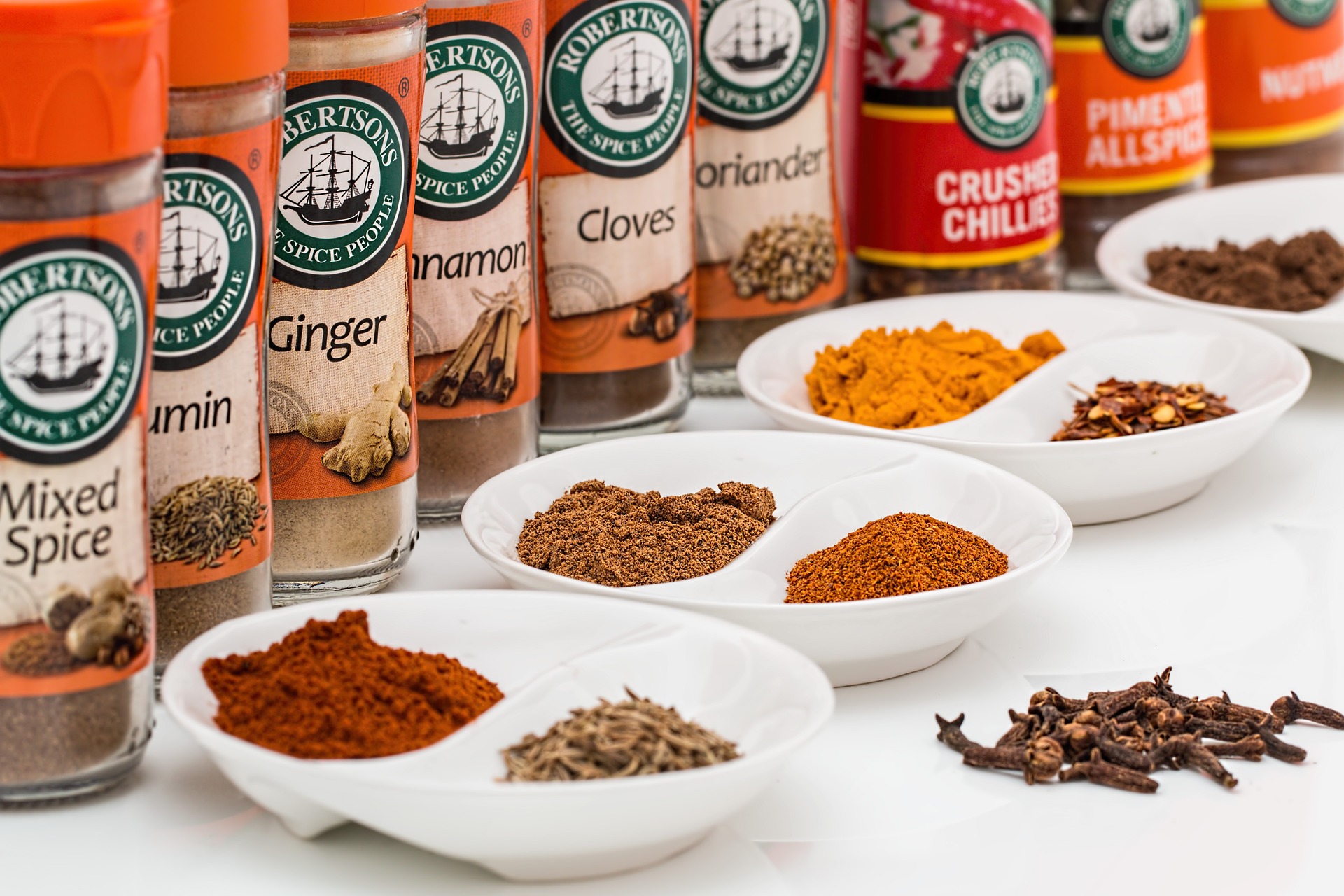

Metadata and taxonomy in your spice rack
Our internal Slack workspace has channels for projects, events, and other work-related items, but of course our most popular channel is #thefoodchannel, where we share recipes, restaurant recommendations, and general foodie discussions.
We love our food, though, and as a result, food tends to leak over into other channels. Most recently a conversation in #scheduling (mostly “hi I’m running an errand”) somehow morphed into a detailed discussion about spice racks and how to organize them.
The primary perpetrator in derailing the channel was, as usual, me.
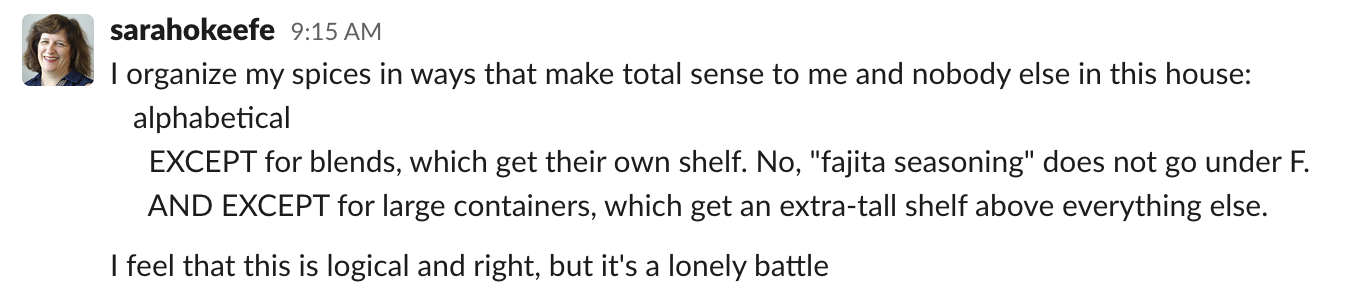
Naturally, I had company…

And others piped up with their taxonomies…

There was a Chaos Taxonomist:

And a set of subclassifications…



Here are a few things you can extract from our assorted “systems”:
- Reference versus functional. An alphabetical system means each jar has an assigned location, but it also means that cinnamon, cumin, coriander, cardamom, chili powder, caraway, and cloves end up grouped together. The “Is it for baking?” approach would separate out cinnamon, cardamom, and cloves into a group with vanilla, ginger, allspice, and nutmeg.
- The FAQ FUS (Frequently Used Spices) approach lets you prioritize easy access to the jars you need most often—at the expense of slower access to the less frequently used spices.
- Some people don’t like taxonomy and prefer to live on the edge.
- OPTs (Other People’s Taxonomies) are weird and bad.
If you are developing a classification system for content, consider that the approach that seems logical and right to you may or may not meet the needs of your audience. My reference-oriented Alphabetical-Plus-Exceptions approach makes sense to me, but neither my coworkers nor the other members of my family seem to have any interest in following it.
One convenient thing to note: once you break out of the physical spice rack, you can have multiple taxonomies. In a digital world, you don’t necessarily have to choose a single organizing principle.
If you want to talk about your approach to taxonomy—for spices or otherwise—contact us.
About the author